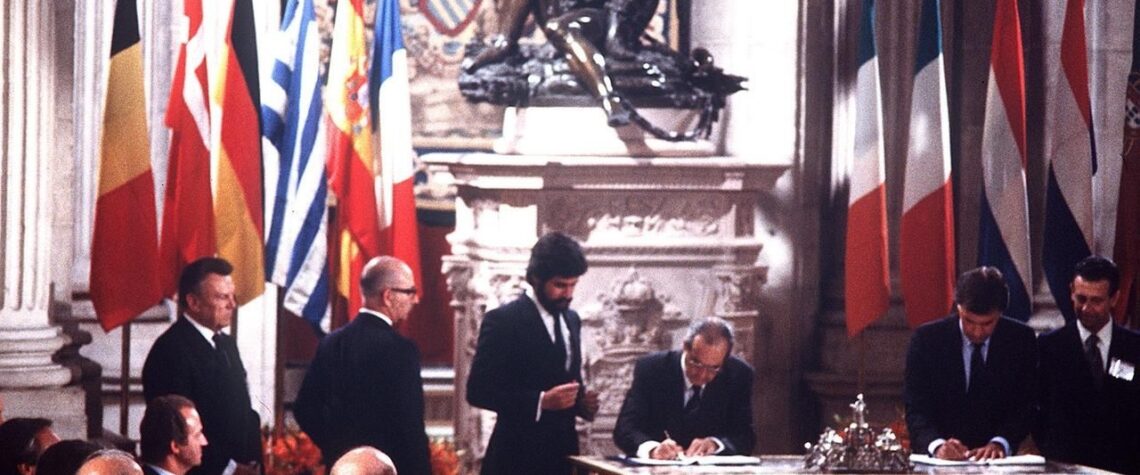
On September 18th, the government of the Balearic Islands and the European Movement hosted a highly symbolic event in Palma: the 40th anniversary of Spain’s accession to the European Communities, today the European Union. The ceremony gathered key political figures, led by former Spanish Prime Minister Felipe González, who personally signed Spain’s Accession Treaty in 1985.
The commemoration, organised by the Government of the Balearic Islands together with the European Movement, also highlighted the crucial role of civic engagement and education. Among the invited participants were three teachers of Sant Josep Obrer school as well as two students of the newly-created optional in Sixth Form “European Union”, Juanma Fernández and Mamakan Keita.
Sant Josep Obrer is partner of the Jean Monnet Project “European Values and Migration“, co-funded by the EU and led by University of Padua.
In his keynote speech, González painted a clear picture of the current geopolitical landscape, marked by instability and the rise of disruptive political leaders worldwide. “Europe is at a decisive crossroads and does not have much time to react,” he warned, urging EU institutions and member states to confront their vulnerabilities with determination.
The former prime minister referred explicitly to political figures such as Donald Trump, Javier Milei and Vladimir Putin, describing them as sources of external pressure that Europe must be prepared to handle. “Trump will not respect anyone who cannot stand their ground,” González stated, adding that “the President of the United States needs Europe far more than the other way around.” His remarks underscored a broader call for stronger European strategic autonomy and leadership.
Security and defence emerged as another focal point of the discussion. González argued that the EU must significantly increase its defence spending, but only through a coordinated, EU-wide strategy. Commenting on Spain’s current military budget, he admitted that it still makes him “laugh”, signalling how far the country remains from the commitments required by the current international context.
Sharing the stage with González was Miquel Roca, one of the fathers of Spain’s 1978 Constitution. Roca delivered an urgent appeal to citizens – especially younger generations – to defend the European project. “If Europe loses strength and cohesion, its citizens will lose progress, freedom and dignity. This is a critical moment,” he stressed.
Although unable to attend in person, businessman and former minister Abel Matutes sent a video message recalling the transformative effect of Spain’s EU accession. He described the moment as “the culmination of an aspiration that brought political stability and trust in the future, fulfilling the hopes of every democrat”.
https://www.focuseurope.it/celebrating-the-eu-at-sant-josep-obrer-school/
Beyond the ceremonial dimension, the event served as a platform for forward-looking reflection. Both González and Roca emphasised that Spain’s entry into the EU not only validated its democratic transition but also pushed Europe to reinvent itself, recognising that its comfortable pace was no longer sufficient.
For the young representatives of Sant Josep Obrer, the anniversary offered more than a lesson in history. It was a vivid reminder that Europe remains a living project – one whose future will soon rest in their hands.